Should You Add Background Music to Your Dental Website?
We're occasionally asked by our clients about adding background music to their dental websites. Years ago, this was a popular trend — it was fairly common practice for developers to add music to pediatric, orthodontic, and general dental websites as a way to add personality and atmosphere.
Times have changed. In those earlier days, multimedia elements were far less common than they are today. Now it's standard for a dental practice to feature patient education videos, welcome messages from the doctor, virtual office tours, and other audio-enabled content. Background music doesn't just feel dated — it actively conflicts with the rich video content most modern dental websites rely on to engage patients.
The User Experience Problem
Although mute controls can be added, there are no universal standards for where to place them. Even when they're logically positioned, visitors often struggle to find them quickly — and that frustration translates directly into bounce rate.
Consider this scenario: a patient has a dental emergency and needs to look up your contact information from work. They pull up your website, and music suddenly begins blaring from their computer speakers. That's not just embarrassing at their workplace — it looks unprofessional on your end. Their most likely reaction? Close the tab immediately and call a different practice. They probably won't come back later.
Mobile Users Expect Silence by Default
The shift to mobile has made background audio even more problematic. The majority of patient traffic to dental websites now comes from smartphones and tablets, and modern browsers on these devices intentionally block autoplay audio to protect users from exactly this kind of disruption. In most cases, your background music simply won't play at all — but the underlying audio file will still load, wasting bandwidth and slowing down your site.
Site speed matters. Slower pages hurt your dental SEO rankings and frustrate patients who expect information instantly. Every kilobyte of unused audio is working against you.
Your Patients Are Already Listening to Something
Many people listen to music, podcasts, or audiobooks through their computers and phones while browsing the web. When your website forces its own audio track into the mix, you're not adding ambiance — you're creating a collision that almost always ends with your site being closed.
Accessibility and Copyright Concerns
Autoplay audio creates serious ADA accessibility issues for users who rely on screen readers, which become impossible to hear when competing audio is playing. This is more than a courtesy — it's a compliance concern.
Copyright is another factor that limits your options significantly. You can't legally put the latest top 40 hit on your website unless it's specifically licensed for commercial use, which is typically either impossible or prohibitively expensive. That leaves you with a narrow selection of royalty-free tracks, most of which sound exactly like the generic "waiting room" music patients are already tired of.
What Works Better Today
Instead of background music, modern dental websites build engagement through:
- Short welcome videos from the doctor or team — with user-controlled audio
- Patient education videos that explain procedures clearly
- Virtual office tours that help new patients feel comfortable before their first visit
- Patient testimonial videos that build trust through real voices
- Clean, fast-loading design optimized for every device
All of these give visitors something valuable when they choose to engage with it — not forced on them the moment they land on your homepage.
The Bottom Line
Background audio on dental websites is a trend that has passed. Unless you're starting a rock band instead of a dental practice, it's better to leave it off. We don't add background music to our clients' websites for all the reasons above. The hard truth is that someone is far more likely to leave your website because of unexpected music than to stay and enjoy it.
At Dentalfone, we help you engage with patients by focusing on thoughtful dental website design and optimizing your site for a full range of devices. If you'd like to talk through what's working on your current website — and what isn't — contact our team and we'll take a look.
Your dental practice logo is a foundational part of your brand identity and overall marketing strategy. It influences how patients perceive your practice and how easily they remember it.
Like any brand asset, however, a logo has a shelf life. It’s worth periodically evaluating whether yours still reflects who you are today.
Consider these factors to determine if your dental practice needs a new logo:
Your Logo is Outdated
It may be hard to believe, but an outdated logo can turn some people away from a brand, including a dental practice. Logos that have been in use for many years may begin to look outdated. What was trendy one or two decades ago may not be appealing today. Perhaps the font style or colors need to be changed to make it more aesthetically pleasing and current. Updating the design periodically can help ensure it continues to resonate with patients.
Your Logo Doesn’t Fit Your Brand or Rebrand
Your logo is your brand’s ambassador, often the introduction to your practice. If it’s not visually appealing and doesn’t represent your dental practice well, it should be redesigned.
Your logo should be one of, if not the first items to update if you are entering a rebrand. It will set the tone for the rest of your dental office’s rebranding strategy.
Your Practice is Changing
Maybe you aren’t officially rebranding, but you are adding new providers, opening a new or additional location, or providing a unique and innovative service. These practice changes may prompt you to consider updating your logo, even slightly, to signify that change and help spread the word.
The Font is Difficult to Read
Whoever designs your dental practice’s logo should follow established logo design principles. If they don’t, you may have a logo with a typeface that is difficult to decipher or color blocks in the wrong areas. If the design is so vague that multiple letters or words appear when viewing the logo, it may be worth considering a redesign.
Your logo should be designed with these principles in mind:
- Originality: The design should be distinctive enough to attract attention and memorable enough to make a lasting impression.
- Versatility: You’ll want to use your logo in many different places, including business cards and outdoor signage—you should ensure it looks good everywhere.
- Scalability: Your logo should be scalable enough to represent your brand anywhere—from a billboard to a tiny pen.
- Simplicity: The design should contain an excellent use of spacing and wise choices in typeface and color.
- Balance & Proportion: The human eye sees balanced designs as beautiful. A well-proportioned design creates visual harmony among the elements of your logo.
- Timelessness: Logos aren’t the place to experiment with design fads. Imagine explaining the thought process behind your logo over and over again for many years. The explanation likely won’t make sense five to ten years from now.
Your Colors May Not Reflect the Right Message
Color choice plays an important role in how patients perceive your practice. In healthcare and dental branding, color often communicates trust, cleanliness, professionalism, and comfort.
For example, certain colors commonly evoke the following impressions:
- Blue is frequently used in healthcare branding because it conveys trust, professionalism, and reliability.
- Green is associated with calmness, health, nature, and renewal, which can reinforce a sense of wellness.
- Neutral tones such as white, gray, and soft earth tones often suggest cleanliness, simplicity, and modern design.
- Accent colors can help highlight key elements of a brand, but they should be used carefully to maintain readability and contrast.
When evaluating your logo, consider whether the color palette reflects the tone and experience you want patients to associate with your practice. If the colors feel outdated, inconsistent with your brand, or difficult to reproduce clearly across digital and printed materials, it may be worth considering an update.
Do You Need Help Updating Your Dental Practice Logo? Contact Dentalfone Today
At Dentalfone, we specialize in marketing services for dental practices nationwide. Our designers have extensive experience working with dental practices and understand the unique considerations of the industry.
Our full suite of services can enhance your online presence and brand identity, including logo design. Our graphic designers will ensure that your new logo accurately reflects the type of dental practice you want your potential and current patients to experience.
Contact us online or by phone at 855-385-3663 today to schedule a consultation.
The way patients search for a dentist is changing — fast.
If your practice isn’t adapting, you may see reduced visibility in the places patients now turn for answers. The biggest shift? The rise of AI-driven search.
Platforms like ChatGPT and Google’s AI-powered search results are reshaping how people research providers, compare options, and choose a dentist. Patients are no longer just typing “dentist near me” into Google and scrolling through blue links. They’re asking conversational questions like:
- “Who’s the best cosmetic dentist near me?”
- “Is Invisalign worth it?”
- “What dentist has great reviews for dental implants?”
- “What dentist with great reviews that is open now is closest to me?”
AI platforms are increasingly providing concise, immediate answers within the search experience, frequently resolving a patient’s question before they ever click to visit a website.
This moment is similar to when smartphones changed everything in 2007. Practices that adapted to mobile-first marketing thrived. Those who didn’t struggled.
The use of AI-driven search tools is increasing.
In this article, we’ll outline what this shift means and provide a practical roadmap to help your practice adapt.
What’s Different About AI Search?
AI represents a meaningful shift in how patients discover and evaluate dental practices.
Instead of relying only on your website, AI platforms pull information from:
- Online reviews
- Google Business Profiles
- Business directories
- Social media posts
- Website FAQ content
- Third-party mentions
If your business listing information is inconsistent, outdated, or incomplete, AI systems may overlook your practice or display outdated information.
For dental practices, that can mean:
- Fewer new patient inquiries
- Reduced visibility for high-value services like implants or Invisalign
- Losing ground to competitors whose online presence is clearer and more consistent
The Core Signals That Influence AI Visibility
Here’s where smart practices are concentrating their efforts:
1. Consistent, Accurate Data Everywhere
AI models rely on accurate and consistent information. Your practice name, address, phone number, hours, services, and provider information must match across all platforms.
Inconsistent data can limit how clearly your practice appears in search results.
2. Review Strength and Reputation Signals
AI search systems often rely on review content as part of how they interpret local businesses. The language (sentiment) patients use in reviews helps AI understand what you’re known for: cosmetic dentistry, sedation, implants, pediatric care, and more.
Reputation management has become a foundational part of digital visibility.
3. Clear Service Authority
AI tools answer specific questions. If your website and content clearly explain procedures, outcomes, FAQs, and patient concerns, you’re far more likely to be surfaced in AI responses.
Service pages that lack depth may be less likely to appear in AI-driven summaries.
Understanding these signals is the first step. The next question is how to act on them. Below is a practical framework dental practices can use to strengthen their visibility in AI-influenced search results.
A Practical Game Plan for AI-Era Visibility
1. Audit Your Business Data Consistency
Review your name, address, phone number, hours, and services across all major platforms. Resolve discrepancies and remove outdated listings. Your name, address, and phone number function as the core identifiers that connect your practice across digital platforms.
2. Strengthen and Monitor Review Content
Encourage patients to leave detailed reviews mentioning specific services. Monitor platforms regularly, try to reply within 24 hours, and respond thoughtfully.
3. Expand and Clarify Service Pages
Ensure each major service includes clear explanations, FAQs, and patient-focused language. Depth and clarity make it easier for search systems to understand your content.
4. Optimize Your Google Business Profile
Keep categories, services, photos, and business updates up to date. Your Google profile remains a primary visibility asset.
5. Maintain Cohesion Across Channels
Align messaging across your website, listings, social platforms, and review sites to create a consistent digital footprint.
How Dentalfone Helps Dentists Stay Ahead
Implementing this kind of framework requires coordination across multiple platforms. At Dentalfone, we help dental practices execute these priorities strategically and consistently.
Educating Practices About What’s Changing
Many dentists don’t realize how quickly search behavior is shifting. We help you understand what AI search means for your practice and how patients are discovering providers today.
Building an AI-Ready Digital Foundation
We help ensure your business data is consistent, optimized, and structured correctly across platforms. This includes:
- Accurate listings management
- Schema and structured data implementation
- Optimized service content
- AI review answering, reputation monitoring and improvement strategies
Strengthening Your Visibility Across Channels
AI search doesn’t pull from just one place. We help your practice build authority across:
- Google search
- AI-enhanced results
- Social platforms
- Review platforms
- Local business directories
When your digital footprint is strong everywhere, AI systems have clearer signals to understand and reference your practice with greater confidence.
Acting as Your Strategic Partner
Beyond tactics, we help you interpret what these changes mean for your patient acquisition. Whether your focus is implants, full-arch cases, cosmetic dentistry, or hygiene production, we align your digital strategy with your business goals.
Now Is the Time to Act
Delaying updates may make it harder to adapt as search continues to evolve.
Just as mobile-first practices gained an edge over a decade ago, dentists who adapt early to AI search are likely to strengthen their long-term competitive position.
Patients are already using AI tools to research providers. The key question is whether your practice is positioned to appear in those answers.
At Dentalfone, we’re committed to helping dentists stay visible, trusted, and competitive — no matter how search evolves.
If you’d like to make sure your practice is AI-ready, call us at 855-385-3663 or contact us today. We’re here to help you navigate these changes confidently.
Search engines are evolving—and so is the way that patients find dental practices online.
AI tools like ChatGPT and Google’s new AI Overviews are changing the way people search. Instead of typing short keyword phrases like “dentist near me,” patients are now asking questions and expecting instant answers, often without clicking on a single website.
With all of the changes to search technology and user behavior, is SEO still worth investing in?
Yes, SEO is critically important in the age of AI.
In this article, we’ll explore how AI is changing search, what that means for dental practices like yours, and how you can ensure your digital strategy stays current.
AI Tools Are Changing the Way Patients Search
AI-powered tools are making it easier than ever for patients to get fast, personalized answers. Rather than scanning multiple websites, they often see a single AI-generated response that summarizes the best available information.
For example, a patient might ask:
- Who’s the best cosmetic dentist near [city]?
- Is Invisalign better than braces?
- What are the signs of gum disease?
Tools like ChatGPT, Bing Copilot, and Google’s AI Overviews are designed to deliver fast, helpful answers to patient questions, often without requiring users to click on a website. If your website offers high-quality information that answers these types of questions, you may be featured in those results.
But if your website lacks in-depth, relevant content, you could be left out entirely — even if you're the top provider in your area.
SEO Still Drives Visibility on Google and AI Platforms
The good news? The fundamentals of SEO still matter in this new search landscape.
Both Google and AI tools rely on many of the same signals to determine which websites are trustworthy and relevant. That includes:
- Optimized content that clearly explains your services
- Mobile-friendly, fast-loading website pages
- Strong local SEO with consistent Name, Address, and Phone (NAP) information
- Positive online reviews and a strong digital reputation
At Dentalfone, we focus on optimizing your website for both traditional SEO and emerging AI search tools, so your practice shows up wherever and however patients are searching.
Content Quality Matters More Than Ever
AI search tools don’t just rely on keywords — they scan for helpful, well-structured, unique content that answers real questions.
That means your website should go beyond listing services. It should provide valuable, informative content that reflects your expertise and builds trust.
Ask yourself:
- Does your site explain the pros and cons of dental implants vs. dentures?
- Do you educate patients about the safety of teeth whitening?
- Do you offer content tailored to your specific community and patient base?
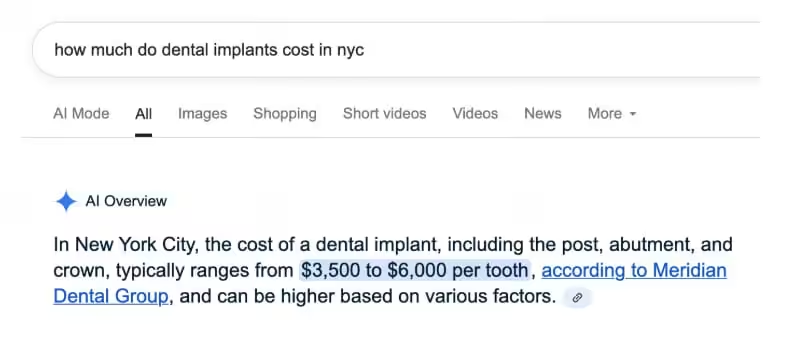
This kind of original content not only boosts your rankings but also increases the chances of being featured in AI-generated answers.
Your Local Presence Is Still Critical
Most patients are searching for care in their area, and that’s not changing anytime soon.
AI tools still use local signals — like your Google Business Profile, online directories, and reviews — to determine which practices to include in search results.
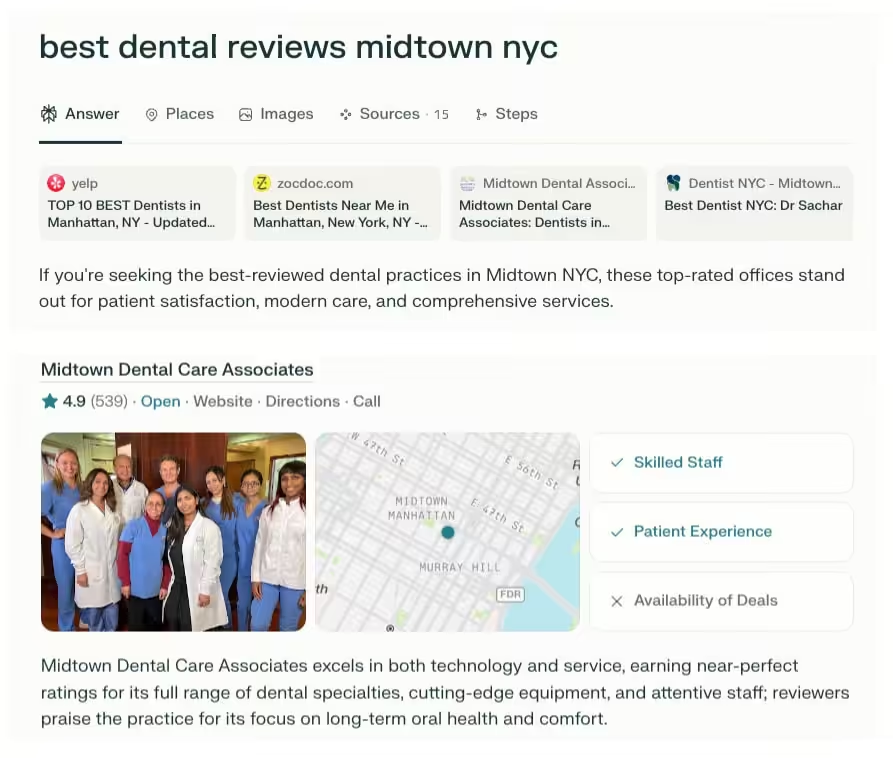
That’s why, at Dentalfone, we emphasize Local SEO as a core part of our dental SEO services. We help ensure your practice’s contact info (such as your Name, Address, and Phone number, your “NAP”) is accurate everywhere, and we optimize your local listings so patients can find you easily.
Future-Proofing Your Online Visibility
Yes, search is changing — but that doesn’t mean starting from scratch. It means your SEO strategy needs to evolve.
At Dentalfone, we help dental practices adapt and stay ahead by:
- Creating original, patient-focused content
- Structuring websites for both search engines AI results, and real users
- Ensuring fast, mobile-optimized website performance
- Building a strong presence across both traditional and AI-enhanced search channels
Our goal is simple: keep your practice visible today—and positioned for success tomorrow.
Is SEO Still Worth It for Dentists in the Age of AI?
Yes, because people are still searching. They’re just using new tools, like ChatGPT, Perplexity, and Claude, alongside Google.
The fundamentals of SEO haven’t changed: patients need to find your website, trust your expertise, and book an appointment. What’s changing is how your content is discovered — and Dentalfone is here to help your practice stay visible across all platforms, new and old.
Request a Visibility Report
Search technology may be evolving, but the goal remains the same: helping patients find your practice.
At Dentalfone, we provide proven dental marketing and SEO solutions tailored to this new era of search. Whether patients are searching on Google or using the latest AI-powered tools, we’ll make sure your practice stands out.
Ready to improve your visibility across Google and AI search? Contact us today to get started.
You’re board-certified. You’re regularly ranked as one of the best dentists in your city. You have the credentials, the experience, and the high-tech equipment required for a successful dental practice. With so much going for you, why should you bother investing in a website and Dental SEO?
In a perfect world, your credentials would speak for themselves and potential patients would overlook an outdated website design, sparsely populated with the bare minimum of content. Unfortunately, we don’t live in a perfect world, and patients and Google are judging you by your dental website design and the questions that your site answers every single day.
Bottom line? If your website isn’t up-to-date, you could be losing potential patients. Here are some of the ways investing in website redesign can help your dental practice.
First Impressions Count
The Stanford Web Credibility Project, which seeks to provide insight into how internet users determine whether a website is trustworthy, finds that 46.1 percent of consumers judge the credibility of a website based on its visual design, including the layout, images, color schemes, and typography. Psychologist B.J. Fogg, the director of the project, explains that:
“People do judge a website by how it looks. That’s the first test of the website. And if it doesn’t look credible or it doesn’t look like what they expect it to be, they go elsewhere. It doesn’t get a second test”.
If your response to reading that was, “yikes!”, you’re right—people are harsh judges when it comes to website design. In fact, most internet users make a judgment about whether a website is high-quality within 50 milliseconds of viewing.
- When your website is outdated, it sends a message that your dental practice is also outdated. When your website is cluttered, it sends a message that your practice is unprofessional.
- When your website is sloppy, it sends the message that you’re careless.
- We could go on, but you get the idea.
Our team of graphic designers and web developers at Dentalfone work to ensure that our clients always make a good first impression with potential patients. You’ll get a custom website redesign that reflects your sensibilities as well as those of your local community. Although every dental website we create is different, what they all have in common is a modern, uncluttered aesthetic that makes it easy for patients to access the information they are searching for.
The Internet Has Changed—and So Have Expectations
There was a time when a homepage that was simply a wall of text, links, and a few low-resolution stock images was sufficient. These days, the internet is more visual and interactive. We’ve gone from small images to large, high-resolution photographs as the centerpiece of each page, and now we’re pioneering a transition from photographs to video.
Dentalfone is on the cutting edge when it comes to incorporating custom photographs and video into dental web design. Your patients want to see you, not a stock photo of a random dentist; they want to take a look at your office, not a generic one you found on Google Images. To reiterate our previous point, appearance does matter. By embracing video and using eye-catching images, you’re sending a signal to patients that your practice is modern and forward-thinking.
SEO is Built-in
When you choose to update your site with Dentalfone and work with our SEO Team, SEO is baked into the process. Our web developers work closely with our local search experts—instead of building a site and then layering in SEO, your site is designed with SEO in mind. It’s in the Hybrid-Responsive interface, the structure of your navigation, and the speed with which your website loads. There is no aspect of our design process that doesn’t take search engine rankings into consideration when you work with our web-development and SEO teams.
Why is this so important? It’s because we know local mobile searches are one of the most significant marketing tools you have as a dental practice. 78 percent of local mobile searches result in an interaction, which means getting your dental website to rank at the top of the first page of search results is virtually guaranteed to grow your practice. We also know that 64 percent of local customers use search engines to find businesses and 46 percent of all Google searches are local. All these statistics add up to one thing: search engine optimization matters.
Unlike paid advertising, once you invest in SEO, the ongoing organic traffic you get from it is free. While ongoing tweaks and updates will always be needed, SEO is much more of a long-term investment than Google Ads. The best marketing strategies incorporate both.
Going Beyond Marketing
Many dental practices view their website as a marketing tool—and it is. But the difference between a good website and a great one is that a great website is a true resource for patients, and it ranks highly on Google page 1 for keywords and long-tail search queries.
Here are some of the ways we design dental websites for our SEO customers that go beyond marketing:
- We create an online library of information for your patients, with detailed descriptions of procedures, aftercare protocols, FAQs, and educational blog posts.
- Dentalfone’s advanced Hybrid-Responsive user interface allows websites to render beautifully across all platforms for ease of use.
- Our available dental forms are mobile-friendly, secure, and HIPAA compliant, allowing your patients to fill out new patient registration paperwork directly on your dental website.
- Dentalfone websites incorporate online appointment request capabilities to make scheduling a breeze.
- In response to the COVID-19 pandemic, we can incorporate new telehealth features into client websites, including online consultations.
(Good) Content is King
We’ve spent a lot of time talking about aesthetics, but that doesn’t mean substance doesn’t matter. The content you put on your website matters a lot, particularly when it comes to Google. Considering that Google has in effect become an “answer” machine, good content sends “signals” to Google establishing your practice as an authoritative source to answer search queries.
Your website should be full of robust, informative content. The key procedures you offer should have a dedicated service page on your website with details to help educate your patients. You should have a blog that’s regularly updated with articles relevant to your practice. Everything you write should be concise and easy-to-skim, as that’s how most people read online.
Google loves high-quality content, but your patients will too. While you’ll want to use content creation as a means of getting important keywords onto relevant pages, it’s also critical to include information that your patients will want to know about your practice. Create a page that covers payment options, the types of insurance you accept, and other practice policies. Anticipate the questions your patients will ask and include them in FAQs.
Find Out How Dentalfone Can Take Your Website to the Next Level
To discuss how we can help expand your website’s reach through professional dental website design and SEO, contact us today.
How to Choose the Best Website Design Agency for Your Dental Practice
No matter the location of your dental practice, patients in your area likely have a lot of choices for their dental care. Standing out among other local practices is imperative to grow your business. You can't do this without a visually appealing and search engine-friendly website.
Your website is a crucial element to the success of the entire marketing strategy for your dental practice. The growth of your practice can hinge on the website designer you hire. Here are some practical tips on choosing the best agency to design your dental practice website.
Is the Website Design Agency Interested in Getting to Know Your Dental Practice Well?
Your prospective website designer should be interested in learning all about you and your business. They should want to know about your dental practice, your business objectives, your website goals, and your audience.
A website designer must deeply understand these elements of your dental practice to design a website that reflects your business. Without such an understanding, you risk ending up with a generic website that doesn't accurately depict what your audience wants to see and learn about your practice.
Are they well-versed in SEO and Digital marketing?
It goes without saying that you want your website to be visually appealing. Still, to be effective, it must also rank well on search engines.
Your website design agency could produce the best-looking website for your dental practice, but if it doesn't meet current digital marketing standards and incorporate the latest search engine optimization (SEO) strategies, it won't show up when your potential dental patients are searching online for a dentist.
When interviewing a potential website design agency, find out what they know about SEO as well as digital marketing, in general, and how they incorporate their knowledge into website design.
What do their previous projects look like? Did they have good results?
When interviewing a website design agency for your dental practice, ask to see samples of their previous work. Read their reviews and find out if they will provide you with some references to speak to prior clients.
Remember to go beyond the visual appeal of their website design work—dig a little deeper when asking questions and evaluating their work products to find out if their website design has had positive results. How do their websites rank on search engines? Did their designs help boost their rankings and, ultimately, their conversion rates and patient numbers?
Dentalfone Brings Reliable Results
At Dentalfone, we know you have a wide range of choices when it comes to website design agencies for your dental practice. However, our clients choose us and stay with us because we bring reliable results. We have the talent, skills, resources, and knowledge to make your dental practice website an effective marketing tool that will help you grow your business beyond what you could have imagined.
To learn more about all we have to offer, call us today at 855-385-3663 or request an appointment online.
We look forward to speaking with you and learning more about your dental practice and business goals.
In the digital world, it’s no longer enough to have quality content–and that’s if readers believe your content is quality to begin with. Leading search engine algorithms like Google and Bing reward original content with higher rankings that stick longer.
Google periodically releases guidelines for how websites should present their content–and what distinguishes average content from stellar content–to offer the best user experience possible. This means that you need to create truly unique and relevant content that answers users’ questions and encourages exploration throughout your site.
This article covers key points about why unique and high-performance content is crucial for SEO success, as well as some strategies you can implement to ensure your blog posts stand out among the millions of content pieces published every week.
Why is original SEO content more important than ever?
The SEO success you crave depends on you and your originality. Long gone are the days when you could write 500 words of industry aphorisms and get all the traffic you want. Now and in the future, your SEO content needs an unmistakable sense of personality and never-before-seen insights your niche can benefit from.
Original content is essential for a few reasons. One, original content is proof the creator put thought into their work. They weren’t going to accept just any arrangement of facts. Two, it reveals the creator cares about their audience. Someone who values their audience wants to help before they sell. Three, originality is one of the few things that can’t be faked. You can use tools for tech SEO and even content improvements, but real creators don’t automate the content creation process.
Unfortunately, many businesses launch their SEO content marketing efforts with re-written content from their competitors, borrowed content from other sources, or even AI content creation tools. Taking this approach isn’t just lazy; it’s often counterproductive. To get real SEO results, you need to write original content from scratch and keep it updated.
SEO, and the importance of original content, can be simplified down to two points. One, original content is useful content. People don’t need rehashed versions of others’ work; they want something noteworthy. Two, you want your content to be as unique as possible so your posts are read, shared, and championed by the people who matter most to your brand.
What are some characteristics of unique SEO content?
The value of originality for SEO content is clear. But how do you distill this timeless principle into actionable content production frameworks?
We narrowed our list down to six leading characteristics of the best-performing, original SEO content:
- The topic must be relevant and practical for your target audience. There’s a reason why so much how-to content reaches the first page of Google. Most people turn to the Internet to find an answer or learn a process. If you have the best how-to blog post for your chosen keyword on the Internet, you’re going to see success from it.
- Your content must be clear, concise, and grammatically correct. This includes being free of spelling, formatting, and image errors. No one will respect content that offers valuable insights but is challenging to read or looks hastily composed. What’s more, many of Google’s recent core algorithm updates place greater emphasis on content authority and trustworthiness. Double- and triple-check your content before it goes live.
- Your images should be high quality, relevant to your words, and include pertinent alt text. Internet users love content that’s visual, and research indicates blog posts with an image every 100 words get shared at least twice as often. Alt text increases your dental website accessibility and also for search engines to see that more of your content is relevant to a user’s query.
- Aim for longer-form content. Content should be long enough to be substantive but not too long to be mentally burdensome. 500 words is a minimum for a focused topic. 1,000 words is about the length it takes to write thoughtfully about four or five subtopics within a main topic. 2,000 words gives you more room to expand on a subtopic or include additional information like frequently asked questions.
- Your blog posts should be published on your website and not on a third-party platform like Medium or Blogger. If you want to generate and retain SEO traffic for years to come, it’s best to publish content where you want people to take action. Medium.com is a nice place to garner brand awareness and cultivate discussions, but it’s not ideal for driving conversions. Show Google which domain it should prioritize and its algorithm will follow suit.
- Your blog posts should be updated once every 90 days to ensure content freshness. Trends, answers, and solutions change all the time–no matter what industry you’re in. That’s why it’s crucial to update your content, even if it’s to add a few links or update your FAQ section. Doing this for all of your content gives Google another reason to trust your site with all of its sweet, sweet traffic.
Benefits of Publishing Original Content
Now that you have excellent content creation principles at your disposal, it’s time to see them in context. The following four sections detail the top four benefits you’ll enjoy when you publish original content:
Reader Begin Seeing Your Site As Authoritative
Google Understands Your Site Content Is Trustworthy
Your Content is More Likely to Go Viral
Your Business Feels Less Corporate and More Personal
10 Strategies for creating high-quality, high-performing content
Knowing what works and putting it into practice are quite different. That’s especially true if you’re building a long-term content plan. Here are 10 plug-and-play tactics to increase the chances that as much of your content as possible makes it to page one:
- Thoroughly research your topic before writing about it.
- Look at the questions that are being searched on your topic (the People Also Ask section) and how they’re being answered.
- Consider which topics are valuable to your target audience, and look for keyword opportunities that don’t yet have a lot of blog posts associated with them.
- Use free tools like Google Trends to help you find topics that are growing month over month.
- Develop a written tone of voice that’s as unique as possible, especially for your industry.
- Ensure your content isn’t too short–aim for 500 words as a minimum.
- Make sure your content isn’t too long and burdensome–remember, 2,000 to 2,500 words should be your upper limit.
- Ensure your content contains enough information to succinctly address the questions readers would have when reading it.
- Include citations for sources, especially about health or financial matters.
- Ensure you have a unique and valid URL for your blog post.
- Ensure you have a unique and valid blog post H1 (the reader-facing title).
The Bottom Line
Original content is important for all websites, especially up-and-coming dental practices. It will give your website a boost in Google, improve your readers’ experiences, and make your brand seem more human and authentic. While it takes time to create original content, it’s always worth the effort.
Need Help With SEO?
Contact us today to request a free search engine visibility report or to learn more about dental websites or for more information about our digital marketing services for dentists.
Google Analytics 4 (GA4) is the newest version of Google’s widely-used web analytics platform. As of July 1, 2023, Google will no longer be recording data via the previous Universal Analytics, so it’s important to get up to speed on Google Analytics 4 right away if you haven’t already.
Keep reading to learn the fundamentals about GA4, including how to set it up, the main features to use, and how to track your data more efficiently.
What is google analytics 4?
Google Analytics 4 is a free web analytics tool that helps businesses track and analyze user behavior on their websites. GA4 measures site traffic, events like conversions, and time spent on page–among other metrics–that help businesses understand their customers better. GA4 offers a more complete view of customer behavior across multiple devices and platforms, including mobile apps.
Key features of google analytics 4
GA4 comes with several new features that make it even more useful. One of its key functionalities is the ability to measure common event types without configuration. Events are user interactions on a website, such as clicks, video views, and form submissions.
Another key feature of GA4 is improved data-driven attribution. Previously, GA primarily offered “last-click attribution,” which states the final channel someone interacted with got credit for a campaign’s result. With Google Analytics 4, users have a more comprehensive view of the channels and marketing initiatives that led to a conversion. Using your findings on a regular basis simplifies the decision making process for future marketing campaigns.
GA4 also provides more valuable integrations, including Display & Video 360, Search Ads 360, and Google Ads. Instead of hopping back and forth between multiple dashboards, see all of your most important Google advertising data in one tool.
Setting Up Google Analytics 4
If you are a Dentalfone client, we have already taken care of this for you. For others, setting up Google Analytics 4 is simple and relatively quick, as long as you’re following the right process. The first step is to create a Google Analytics account (if you don’t already have one). You can do this by going to the Google Analytics website and following the prompts to create an account.
Once your account is created, you need to create a new property for Google Analytics 4. Click on the “Admin” button and select “Create Property.” Continue following the onscreen prompts to finish setting up your GA4 property. When you’re done, you’ll see a confirmation message.
Once the property is created, it’s time to add the tracking code to your website. This is a string of code that’s added to the backend of your website to ensure GA can properly collect data from your site. If you need help installing the tracking code, follow Google’s setup guidelines and you’ll be set in just a few minutes.
Understanding the Google Analytics 4 Interface
For Dentalfone SEO customers, you will have a custom portal that provides a simple interface for understanding and tracking your site's performance. For others, the GA4’s interface is designed to be more user-friendly and customizable than the Universal Analytics interface. It has a more modern look and feel and is organized into three main sections: Home, Analysis, and Configure. Here are details about each section:
- Home: Provides a high-level overview of key metrics, such as user behavior, traffic sources, and user demographics.
- Analysis: Offers deeper insights into user behavior, including user journeys, events, and conversions.
- Configure: Allows you to customize your Google Analytics 4 account, including creating custom reports and dashboards.
Differences Between Google Analytics 4 and Universal Analytics
Google Analytics 4 is different from Universal Analytics in several ways. One of the main differences is the tracking method. Google Analytics 4 uses an event-driven model, while Universal Analytics used a pageview-based model.
Another difference between the two is the reporting system. GA4 provides more advanced and customizable reporting options than Universal Analytics. It also provides deeper insights into user actions, like reporting on engaged sessions instead of just site bounces.
Yet another difference is that GA4 provides better cross-device tracking, making it simpler and faster to understand customer behavior across multiple devices. This data helps your web development team implement changes faster, your marketing team understand campaigns earlier, and your sales team capitalize on testimonials better.
What to Know About the transition to google analytics 4
If you’re already a Dentalfone SEO client, rest assured we’ll handle all aspects of your Google Analytics transition for you. Our web development team has completed thousands of site maintenance and migration tasks, and this is no different.
If you have questions about the transition to Google Analytics 4 or need help, please contact us.
The Bottom Line
Google Analytics 4 is Google’s latest and greatest iteration for understanding your site and app visitors and the actions they take. Integrating your GA4 account with other Google tools, such as Google Ads and Google Tag Manager, provides an even more powerful view of user behavior.
Are you looking for an agency you can trust your dental practice marketing with? Request a free quote now. We’ll help you transform your practice into the success story you’re dreaming of!
The spring of 2020 was a difficult time for many of our clients. COVID-19 was new, there was uncertainty about how it was transmitted, and dental practices closed their doors to everything except emergency care. As we learned more about the virus, dental practices were able to open back up, and once vaccinations were widely available, it seemed like COVID-19 would soon be a thing of the past. Unfortunately, the emergence of the Delta variant has proven that COVID-19 is likely here to stay—at least for the time being. This means it’s time to make sure your patients are aware of the COVID-19 protocols at your dental practice.
Local profiles and COVID-19 protocols
In addition to putting updates on your website, updating your local business profiles is an easy way to publicize the steps you’re taking to keep patients safe. We're assuming you're already using Yelp, Google My Business, and Bing Places, so all you have to do is log in and take advantage of the built-in features to share updates on your dental practice’s operations during COVID-19.
Updating COVID-19 protocols on google my business
Your Google My Business profile should be the first place you share COVID-19 updates, since both new and existing patients may land on your website from Google. There are a few different ways to update your GMB profile with your COVID-19 protocols.
To create a GMB post about your protocols, use the COVID-19 Update option in posts. The next way to update your profile is by going to Health and Safety in your settings and choosing from the following options:
- Mask required
- Temperature check required
- Staff wear masks
- Staff get temperature checks
Updating COVID-19 Protocols on Yelp
COVID-19 protocols can be shared in a variety of ways on your dental practice’s Yelp profile. First, you can let your patients know if you're open or closed. If your practice is open to patients, you can add virtual consultations as an option, then check the boxes for any health precautions you've taken. Among the options are:
- Proof of vaccination required
- All staff fully vaccinated
- Masks required
- Staff wears masks
To share additional messaging with potential patients, you may also place a banner message at the top of your Yelp profile. This is a good place to share other safety measures your practice has implemented.
Why It Matters
As the Delta variant spreads across the United States, patients will return to feeling hesitant about visiting the dentist for needed care. You can assuage these concerns by making it clear that you’re taking all of the necessary steps to keep your patients safe.
In addition, by letting patients know what to expect before they come to your dental practice for an appointment, you can avoid potential conflicts over mask wearing and social distancing, which reduces the burden on your staff in enforcing your office’s guidelines.
Get help updating your local profiles with Dentalfone
If you need help staying on top of your local profile updates, schedule a meeting with Dentalfone SEO.
As a dentist, keeping up with the latest in SEO and social media can feel like a Sisyphean task. Just when you think you have a handle on SEO, there’s an algorithm change; as soon as you’ve mastered all of your social media platforms, a new one pops up.
One of the more recent updates with Local SEO is the rise of Google Business posts. In this article, we’ll get you up to speed on Google Business, Google Business posts and the importance of incorporating this activity within your SEO strategy.
What is google business?
Whether or not you’re a current Dentalfone client, we’re betting you’re familiar with Google Business. This is a feature Google offers local businesses to allow them to manage their own presence on Google Search and Google Maps. As a dental practice, local search is the front door to any SEO strategy, so if you’re not already active on Google Business, it’s time to get started.
Google Business gives you the ability to take charge of your own information on Google; if you don’t use Google Business, Google will decide on its own what to share with potential patients about your practice and it may not be accurate. When we start working with clients on Google Business, it’s not unusual to find old office locations, prior practitioners that worked at the practice and inaccurate business hours listed in Google.
What are google business posts?
In the past, Google Business focused on essential business information, maps, and reviews. Now, businesses also have the opportunity to share updates with Google Business posts. General updates, CV-19 announcements, special offers and much more are now available, all of which help drive additional search traffic to your practice website.
Here’s what a Google Business post looks like:
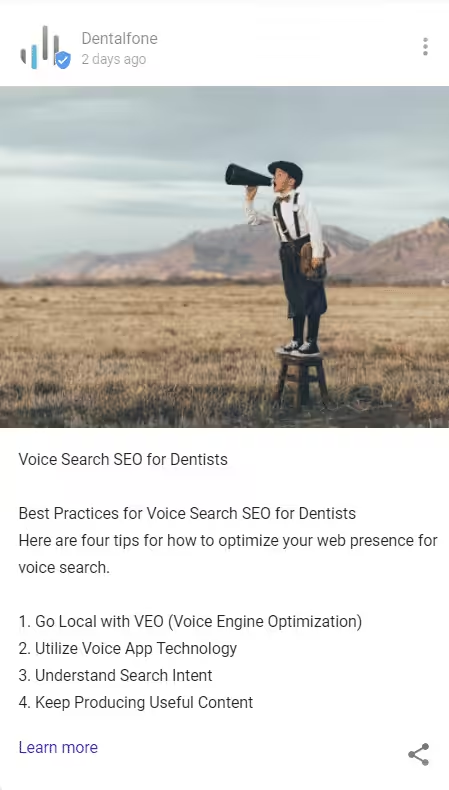
If we were to compare Google Business posts to another social media platform, we’d say they’re most like Facebook profile updates — you can include text, images, and links with your latest blog posts, promotions, or office news. In fact, if you don’t have the time or budget to dedicate to Google Business posts, we recommend simply repurposing your Facebook posts for the platform so you’re consistently sharing content there.
How often should you post to Google Business? We recommend sharing posts to your account at least once a week.
How to use google business posts for your dental practice
Most of your updates should have images to grab attention as well as a caption that is engaging and encourages conversion. Google Business posts are ideal for sharing upcoming events, offers or discounts, hour updates, and new services. Here are some quick tips to get you started:
- Use high quality images and videos in your posts. Pictures that are blurry or have low resolution will make your practice look unprofessional and outdated.
- Don’t max out the character limit. Keep it short and simple—people should be able to skim your updates and get the gist of what you’re saying.
- Have a clear call to action. For a blog post, it could be “read more on our website.” Advertise a promotion by asking people to book an appointment today. Every Google Business post should have a purpose and the CTA is where you make that purpose clear.
- Keep it professional, but friendly. Google Business isn’t Instagram; avoid excessive exclamation points, slang, emojis, and anything that sounds too informal.
- Don’t be afraid to experiment. We recommend trying different types of offers and promotions and analyzing how they perform. As you begin to see what works and what doesn’t, you can refine your Google Business strategy.
The optimization of your Google Business profile is the number one ranking factor for local businesses. Like everything related to Google, there’s no transparency about whether and how Google Business posts factor into ranking, but what we do know is that they’re displayed when people search for your business and they give you the power to share what you want potential patients to know about your dental practice, at the precise moment that they are searching for your services.
Learn how dentalfone can help manage your dental practice's google business presence
If you’re struggling to keep up with Google Business posts, our team of local search experts at Dentalfone can help. Contact us today at 855-385-3663 to find out more about our dental SEO services.