The spring of 2020 was a difficult time for many of our clients. COVID-19 was new, there was uncertainty about how it was transmitted, and dental practices closed their doors to everything except emergency care. As we learned more about the virus, dental practices were able to open back up, and once vaccinations were widely available, it seemed like COVID-19 would soon be a thing of the past. Unfortunately, the emergence of the Delta variant has proven that COVID-19 is likely here to stay—at least for the time being. This means it’s time to make sure your patients are aware of the COVID-19 protocols at your dental practice.
Local profiles and COVID-19 protocols
In addition to putting updates on your website, updating your local business profiles is an easy way to publicize the steps you’re taking to keep patients safe. We're assuming you're already using Yelp, Google My Business, and Bing Places, so all you have to do is log in and take advantage of the built-in features to share updates on your dental practice’s operations during COVID-19.
Updating COVID-19 protocols on google my business
Your Google My Business profile should be the first place you share COVID-19 updates, since both new and existing patients may land on your website from Google. There are a few different ways to update your GMB profile with your COVID-19 protocols.
To create a GMB post about your protocols, use the COVID-19 Update option in posts. The next way to update your profile is by going to Health and Safety in your settings and choosing from the following options:
- Mask required
- Temperature check required
- Staff wear masks
- Staff get temperature checks
Updating COVID-19 Protocols on Yelp
COVID-19 protocols can be shared in a variety of ways on your dental practice’s Yelp profile. First, you can let your patients know if you're open or closed. If your practice is open to patients, you can add virtual consultations as an option, then check the boxes for any health precautions you've taken. Among the options are:
- Proof of vaccination required
- All staff fully vaccinated
- Masks required
- Staff wears masks
To share additional messaging with potential patients, you may also place a banner message at the top of your Yelp profile. This is a good place to share other safety measures your practice has implemented.
Why It Matters
As the Delta variant spreads across the United States, patients will return to feeling hesitant about visiting the dentist for needed care. You can assuage these concerns by making it clear that you’re taking all of the necessary steps to keep your patients safe.
In addition, by letting patients know what to expect before they come to your dental practice for an appointment, you can avoid potential conflicts over mask wearing and social distancing, which reduces the burden on your staff in enforcing your office’s guidelines.
Get help updating your local profiles with Dentalfone
If you need help staying on top of your local profile updates, schedule a meeting with Dentalfone SEO.
As a dentist, keeping up with the latest in SEO and social media can feel like a Sisyphean task. Just when you think you have a handle on SEO, there’s an algorithm change; as soon as you’ve mastered all of your social media platforms, a new one pops up.
One of the more recent updates with Local SEO is the rise of Google Business posts. In this article, we’ll get you up to speed on Google Business, Google Business posts and the importance of incorporating this activity within your SEO strategy.
What is google business?
Whether or not you’re a current Dentalfone client, we’re betting you’re familiar with Google Business. This is a feature Google offers local businesses to allow them to manage their own presence on Google Search and Google Maps. As a dental practice, local search is the front door to any SEO strategy, so if you’re not already active on Google Business, it’s time to get started.
Google Business gives you the ability to take charge of your own information on Google; if you don’t use Google Business, Google will decide on its own what to share with potential patients about your practice and it may not be accurate. When we start working with clients on Google Business, it’s not unusual to find old office locations, prior practitioners that worked at the practice and inaccurate business hours listed in Google.
What are google business posts?
In the past, Google Business focused on essential business information, maps, and reviews. Now, businesses also have the opportunity to share updates with Google Business posts. General updates, CV-19 announcements, special offers and much more are now available, all of which help drive additional search traffic to your practice website.
Here’s what a Google Business post looks like:
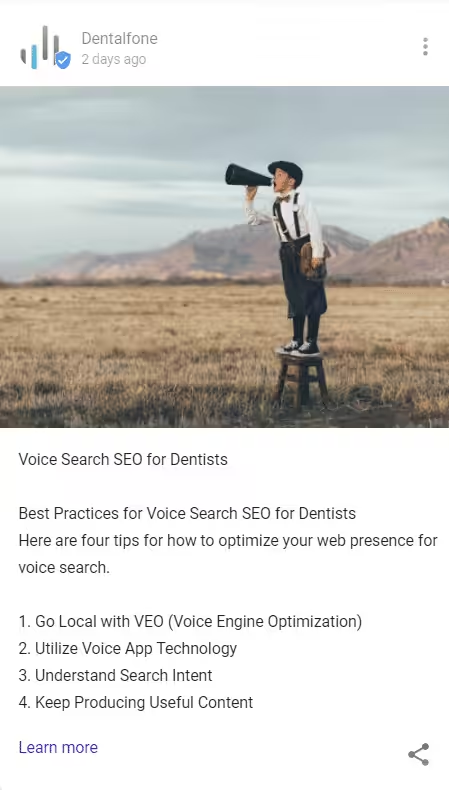
If we were to compare Google Business posts to another social media platform, we’d say they’re most like Facebook profile updates — you can include text, images, and links with your latest blog posts, promotions, or office news. In fact, if you don’t have the time or budget to dedicate to Google Business posts, we recommend simply repurposing your Facebook posts for the platform so you’re consistently sharing content there.
How often should you post to Google Business? We recommend sharing posts to your account at least once a week.
How to use google business posts for your dental practice
Most of your updates should have images to grab attention as well as a caption that is engaging and encourages conversion. Google Business posts are ideal for sharing upcoming events, offers or discounts, hour updates, and new services. Here are some quick tips to get you started:
- Use high quality images and videos in your posts. Pictures that are blurry or have low resolution will make your practice look unprofessional and outdated.
- Don’t max out the character limit. Keep it short and simple—people should be able to skim your updates and get the gist of what you’re saying.
- Have a clear call to action. For a blog post, it could be “read more on our website.” Advertise a promotion by asking people to book an appointment today. Every Google Business post should have a purpose and the CTA is where you make that purpose clear.
- Keep it professional, but friendly. Google Business isn’t Instagram; avoid excessive exclamation points, slang, emojis, and anything that sounds too informal.
- Don’t be afraid to experiment. We recommend trying different types of offers and promotions and analyzing how they perform. As you begin to see what works and what doesn’t, you can refine your Google Business strategy.
The optimization of your Google Business profile is the number one ranking factor for local businesses. Like everything related to Google, there’s no transparency about whether and how Google Business posts factor into ranking, but what we do know is that they’re displayed when people search for your business and they give you the power to share what you want potential patients to know about your dental practice, at the precise moment that they are searching for your services.
Learn how dentalfone can help manage your dental practice's google business presence
If you’re struggling to keep up with Google Business posts, our team of local search experts at Dentalfone can help. Contact us today at 855-385-3663 to find out more about our dental SEO services.
We always ask our clients to include biography pages on their websites. While these pages may seem inconsequential when compared to service and contact pages, many patients do read doctor bios before making their first appointment at a dental practice. If the services you offer are the same as other practices in your area, your biography gives you the opportunity to differentiate yourself.
What do patients look for in a dentist's biography?
There are two key components that should be included in a good biography: your professional accomplishments and your personal story. The former will help patients decide if you have the qualifications they’re looking for in a dentist, while the latter helps them connect with you on a more personal level.
Your biography shouldn’t read like a resume; think of it more like an introduction you might give to someone when you meet them for the first time. We’ve seen some doctors simply list their alma matters and professional memberships in lieu of writing a biography, which might satisfy one of the criteria for a good bio, but it certainly doesn’t foster any kind of personal connection.
Here’s the minimum of what you should include in your biography:
Professional Accomplishments
- Your education and residencies
- Any notable continuing education
- Leadership positions
- Awards and recognitions
- Certifications
- Professional association memberships
- Teaching positions
Personal Information
- Volunteer work
- What made you decide to become a dentist
- Community connections
- Hobbies
- Family life
When it comes to sharing personal information, there’s certainly no need to go into more detail than you feel comfortable with, but patients like to know a little bit about who their dentists are as people. It’s not so much what you say about yourself, but the fact that you share a little bit of who you are. No one will read your bio and say, “Well, Dr. Smith loves playing soccer and I do too, so I’m going to choose his practice!”, but getting to know you as a person creates a more comfortable, familiar relationship with patients.
Writing the Perfect Biography
Now that you know what you should include in your biography, let’s talk about how to write it. Here’s a brief template to use if you’re not much of a writer:
Hi, I’m Dr. Mary Brown. I grew up in ___________(city, town) and attended college at ___________________. From there, I went on to dental school at ___________, completing my degree in ________________(year). After that I trained at ___________ for ________ years in the residency program. (Or I worked as an associate at _____ for _____ years). In _________(year) I relocated to _______________ with my husband/wife. We have _____ kids and enjoy… (lists some hobbies and interests).
For the 2nd paragraph, list what makes you passionate about your profession. If you work in a multiple doctor practice it’s best if these don’t all sound the same. Perhaps you love technology and how it benefits your patients. Maybe you have a passion for continuing education and the benefits it brings your patients. What are your goals for the patient experience? Try to speak from the heart with a few sentences on what you enjoy about what you do and how that passion impacts your patients. Be specific—every dentist says that they’re gentle, that they listen to their patients, that they provide exceptional care. How do you do that?
If you decide to write your own biography from scratch, spend some time thinking about the tone you’d like to take. Most doctors play it safe and strike a balance between friendly and professional, but if you have a highly specialized practice, you may want to skew towards formal; if you’re known for your sense of humor, your bio is the best place on your website to inject some levity.
The Bottom Line
Writing a solid biography doesn’t need to take more than 15 to 20 minutes and that time investment will pay dividends. Getting your patients to connect with who you are as a person is our primary goal. A great biography combined with an excellent photograph helps patients see who you are as a person so they can feel comfortable picking up the phone to make an appointment.
Need help building your dental website? Contact Dentalfone today for a quote.
Smartphones have changed digital marketing in countless ways, and geofencing is perhaps one of the most exciting. Traditionally, digital ad targeting was done by demographics, interests, and home address, but geofencing allows marketers to target ads based on the current location of a mobile device. In other words, someone might live in Omaha but be traveling to Chicago on business, and when they’re in Chicago, they’ll see ads for local restaurants and attractions while browsing the internet on their phone. When they’re back home in Omaha, they’ll stop seeing these ads.
How geofencing works
There are a number of reasons to implement geofencing in your digital marketing efforts:
Expand your ad Reach
If you’re currently only using Google Ads and/or Facebook Ads, then you’re missing out on opportunities to get in front of prospective patients. For example, a pediatric dentist could target nearby daycare centers to get in front of parents that may not be actively searching in Google. This is an opportunity to introduce your office without the distraction of other competitor ads.
Improved ROI
Geofencing allows you to target the audiences who are most likely to visit your dental practice. When combined with other forms of targeting, you can decide who sees your ads with laser precision, maximizing your ROI.
Track Real Visits
With other forms of advertising, success is typically measured by phone calls or form submissions on the website. The problem is that not all of those leads turn into patients in your office. With geofencing, conversions are actual visits because the technology uses your office address as the conversion zone. That means you’ll know exactly how many patients showed up to your office after viewing or clicking on your ads.
Examples of Geofencing for dentists
We know what you’re thinking: This all sounds great, but it also doesn’t sound like something that would work for my dental practice.
It may seem that way on the surface, but with a little creativity, you can make geofencing work for you. Here are some ideas:
- Geofence around retirement communities to advertise dental implants or dentures.
- Geofence around medspas, plastic surgery clinics, and high-end salons to advertise cosmetic and/or reconstructive dentistry services.
- Geofence around newly-built subdivisions to advertise to people looking for a new dentist.
- Geofence around gyms to advertise custom mouth guards.
- Geofence around playgrounds and schools to advertise pediatric dentistry services to parents.
- Geofence around chiropractic practices and alternative medicine clinics to advertise holistic dentistry.
- Geofence around competing dental practices to advertise your superior (or more affordable) services.
While there are not quite as many opportunities in geofencing for dentists—going to the dentist isn’t a spur of the moment decision for most people, after all!—as you can see, there are some exciting ways to set up geofenced campaigns to promote your dental practice.
Learn more about geofencing for dentists
Contact us today to discuss how Dentalfone can help you set up geofencing for your digital dental marketing campaigns.
When it comes to marketing a dental practice, smartphone optimization is crucial. People spend far more time on mobile devices than on their computers these days, which means they're also conducting their online searches on their phones. When a potential patient searches for a dental practice on a mobile device, the user's location is taken into account, especially with the local pack and Google Map results, making "near me" searches that seek hyperlocal results more common than ever before.
"Near Me" Searches Become the Norm For Finding Dentists
Local searches with the qualification "near me" grew 150 percent in 2017, showing significantly more growth than searches without that term, according to Think With Google. This indicates that when people search for businesses like dental practices, they prefer to view a list of results that are nearest to them, rather than simply retrieving a list of dentists in the same town or county.
Users are seeking even more granular information from types of searches, according to Think With Google data, using terms like "where to buy" and "on sale" in addition to the "near me" qualifier. This information should influence how you approach local SEO for your dental practice. Instead of "dentist near me," people may be searching phrases like, "where to get teeth whitening near me," or "Invisalign promotion near me."
Dentists Near Me: Now Hyperlocal
When prospective patients use their smartphones to look for a dental practice near them, they're often presented with a list of dentists that aren't just in their town, but in the very neighborhood where they're searching. The term we use for this is hyperlocal, and it's not just the future of local search but the future of marketing your business.
To utilize the popular website Nextdoor, users must first enter their address; they are then connected to the appropriate neighborhood based on their address and asked to submit a recommendation before searching for a (hyper-)local business near them—like a dentist.
Nextdoor searches return results that are hyperlocal to the user's chosen neighborhood. When local search resource AdviceLocal created a test account and looked for a business outside of its designated neighborhood, they could not find it in the results—only businesses in the neighborhood were shown.
We believe that hyperlocal marketing and search are critical for dental practices. We're seeing a growing number of online businesses set up in this fashion, from news websites like BubbleLife to food delivery apps. If you haven't done so already, now is the time to claim your business listing on Nextdoor and keep informed about new hyperlocal prospects for your practice.
Facebook Neighborhoods: A New Hyperlocal Concept
Facebook announced in May 2021 that it would be testing its new Facebook Neighborhoods feature in Canada. Facebook Neighborhoods, a potential competitor to Nextdoor, allows neighbors to interact and provide recommendations to each other. Residents will be able to vote for their favorite hyperlocal businesses, services, and places using popular features like polling, which will be integrated into these Neighborhood communities.
Should Facebook Neighborhoods be released in the United States, it will be critical to claim your business listing and make the most of any features offered to promote your dental practice to the surrounding community. Getting in on the ground floor will give you a leg up on other dentists in your area.
Learn More About Local and Hyperlocal Search
Dentalfone can assist you if you're feeling overwhelmed by the trend to hyperlocal and the increasing demands of local search for your dental practice. To learn more about our dental SEO services and how we can help you stay on top of your competition, contact us today.
You already know that as a dentist, local SEO is critical to your success. There are a number of steps you can take to optimize your local SEO strategy and one of them is local listing management, also referred to as online business directories. Here’s what that means and how our local search experts at Dentalfone can help.
Understanding Local Listings
Your dental practice’s information is all over the internet. The most important pieces of data from a local search perspective are the name of your practice, its address, and its phone number, which we often short-hand as NAP. Your NAP is in local directories, on your website, in press releases, your city’s chamber of commerce website, and elsewhere. The more places your NAP appears, the stronger your overall visibility and performance in local search. Your NAP is the “glue” that connects your practice to the Internet.
Local listing data goes beyond NAP, though. For a dental practice, other important information in local listings includes your dental specialty, your office hours and days of operation, the specific services you offer, and the names of your primary employees. The name, address, and phone number are primary pieces of data for your local listing, while these other pieces of data are considered secondary.
The Importance of Local Listing Management
We want local listings for your dental practice to appear all over the web, but here’s the caveat: the more places your listing is located, the more work you have to do to manage these listings. That’s because it’s not enough to simply show up everywhere—as Google and other business directories are binary, the information displayed about your office must also be accurate and consistent.
When there is incongruence between different directories and websites, it has the potential to hurt your business because business directories, mapping apps, and review websites don’t know which information source is trustworthy; to avoid sharing inaccurate information about your practice, Google may opt to recommend your competitor over you because it’s more certain as to the accuracy of their primary and secondary data.
This might not seem fair, but think about times when you’ve followed Google Maps’ directions to a business only to find that it moved or that the hours listed on Google were inaccurate. It’s frustrating, isn’t it? Search engines don’t want to create these kinds of situations for their users, which is why they place such an emphasis on data that is consistent across a number of different local directories and websites, because consistency is an indicator of accuracy.
According to BrightLocal (an integrated SEO and local citation platform that provides SEO experts with some of tools necessary to help increase the visibility of your business and attract more patients using local search.), 80% of consumers lose trust in a local business if it has incorrect or inconsistent contact details and 40% would give up looking for a local business they couldn’t find because the address was wrong online.
Why It Pays to Have Dentalfone Manage Your Local Listings
Managing your local listings yourself is time-consuming for you and your staff. Wouldn’t you rather focus on what you do best? Leave local listing management to us and we’ll do the work to ensure that all of the information available online about your business is accurate and consistent.
Our work doesn’t end there, though. We provide daily monitoring for new local listings and, should you change your office hours or location, we’ll make updates to your local listings across the web. We leverage our relationships with the leading online directories and data sources to get results fast.
Learn More About Local Listing Management
To discuss how we can help your dental practice with local listing management, schedule a meeting with Dentalfone SEO.
Many customers and companies worldwide have recently received notices through contact forms or email accounts accusing them of photography copyright violations.
These fake notices will usually include a link to an attachment that the sender wants you to click. It is critical that you DO NOT click the link as these links are often used to spread ransomware and are likely to infect your computer.
You can see an example of one of these notices in the below screenshot.
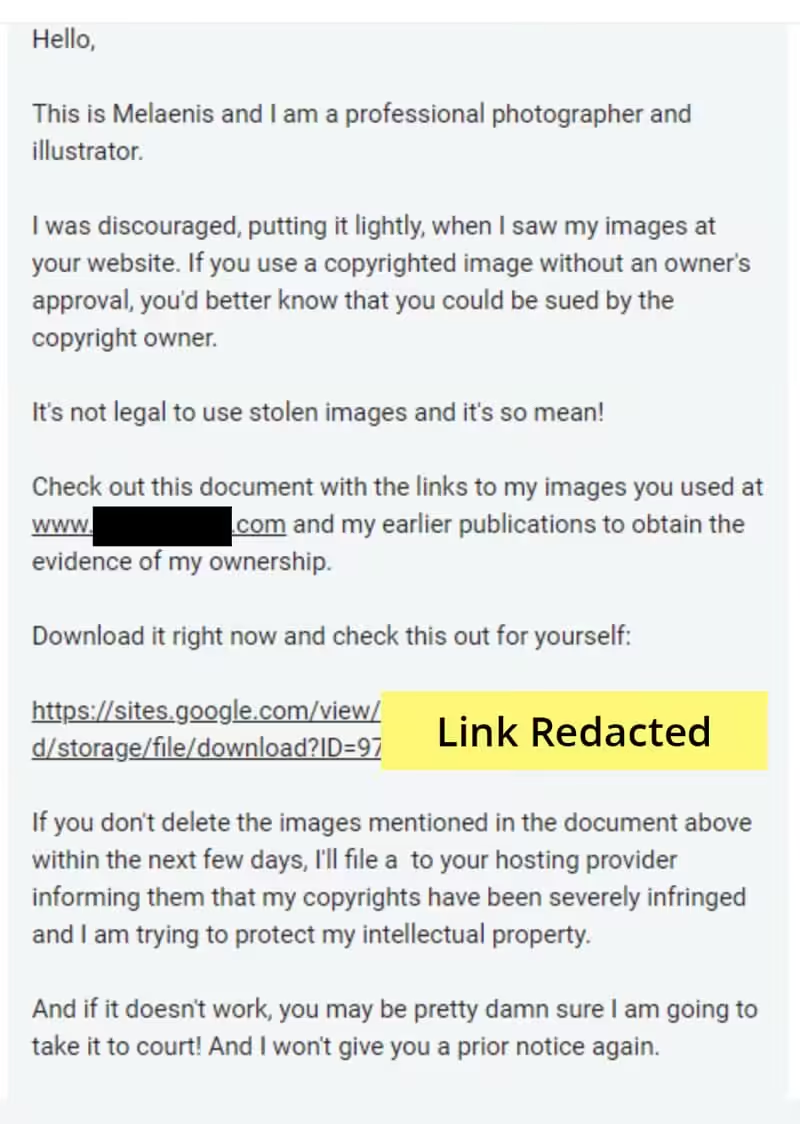
These emails can sound scary, and the goal is to prompt the receiver to be alarmed so that they click on the link.
In general, you should never click on links sent by unknown senders as they may contain malicious files. Clicking the link will download a file containing code that may infect the computer with ransomware.
At Dentalfone, we take copyright very seriously. We are careful to use images licensed from our stock photography company or unique pictures that a photographer has taken in your practice.
If you think you have received a valid notice of copyright infringement, you should forward a screenshot of the message to your IT or Website company for them to review. Still, if it looks similar to the above, it’s fraudulent, and the best course of action is to delete the message.
If you have received one of these messages and clicked on the link, you should reach out to your IT company immediately, so they can do an audit to check your computer systems and work on cleaning up any infections if present. This is also an excellent reminder to make sure your practice has a stringent data backup process, with regular rotations of backups, including off-line backups stored off-site.
As hackers become more sophisticated, it is more important than ever to be vigilant when reviewing emails, being careful not to click on links that may create security issues or negatively impact your business.
One of the CURRENT SCAMS facing dental practices is a letter regarding the SOLICITATION TO RENEW YOUR DOMAIN NAME from an unauthorized source, which may appear to be a legitimate renewal notice.
There are 2 types of notices we regularly see come in the mail or e-mail:
#1: You receive a notice to renew your domain and the notice has a domain name that isn’t your actual domain name. It is very close to your name but not your domain name.
These notices are intended to get you to think that your domain name is up for renewal and they are hoping that you won’t notice the slight difference in the domain name. They are hoping you will go ahead and pay for the renewal at an inflated price.
#2: You receive a notice with your EXACT domain name, but it’s not from the company that manages the domain or a company that is authorized to renew your domain.
This letter tries to get you to think that they are the company you used and/or they are authorized to renew your domain. They will use your EXACT domain name in the e-mail (or letter).
CAUTION: If you are not sure who your domain name is officially registered with, you should contact your website provider BEFORE you pay for the renewal.
In most cases, your website provider takes care of the renewal for you and bills you for that service with your monthly hosting and maintenance fees.
TIP: Research the information before acting. Don’t pay any invoice for domain renewals if you are not 100% certain of their validity. If you receive a domain name renewal notice and are not sure if it’s real, feel free to scan and e-mail a copy of the notice to us, so we can let you know if it’s legitimate.
We hope you find this information helpful.
Your friends at Dentalfone!
The challenge of search engine optimization is staying on top of ever-changing algorithms and trends. What worked yesterday might not work today, and what works today has a very good chance of being obsolete a year from now. Good SEO is built upon a foundation of high-quality content, something that will serve your dental practice well through any changes in technology and algorithms. We’re seeing this play out as voice search rapidly changes the SEO game.
Best Practice for Voice Search SEO for Dentists
Here are four tips for how to optimize your web presence for voice search.
1. Go Local With VEO (Voice Engine Optimization)
Build up your local bona fides by focusing on your Google My Business, Bing, and Yelp profiles. One of the most common ways people use voice search is to locate businesses near them—and your local profiles are one of the primary ways for search engines to know that your business is trustworthy, legitimate, and worth recommending to users. According to BrightLocal, search engines take the following into consideration in SERPs for voice search:
- The proximity of the business to the searcher’s location
- How the business interacts with customer reviews
- How many backlinks the business’s website has
- Social media presence and activity
- Visibility in industry and local directories
In other words, investing in local search pays dividends when it comes to getting your dental practice noticed.
2. Utilize Voice App Technology
If someone is using Google Assistant or Alexa to ask what to do when a crown falls out, do they want to read the answer? Or would a voice response be more helpful? Consider investing in conversational voice app technology to answer frequently asked questions and explain common dental procedures. While this might not be a must for SEO right now, it will give you an advantage in a competitive market and in a few years, this type of technology may be a prerequisite for ranking well in a Google Page 1 search result. (Contact us and speak with our Director of SEO, Robert Messinger, if you’re more interested in learning about our voice app technology solutions.)
3. Understand Search Intent
People use voice search differently than text search, but when it comes to voice search SEO, it’s more important than ever to understand the why’s and how’s of search. How are people finding your site? Why are they using the keywords they’re using?
“What do I do if my dental crown falls out?” has a different search intent than “emergency dentist near me who repairs crowns.” The latter wants to find a dentist to call; the former may or may not be ready to schedule an appointment and they’re primarily looking for information.
Don’t attempt a bait-and-switch and try to attract users with one keyword in order to direct them to something completely different — this is a surefire way to sink your rankings with voice search. If you don’t offer traditional dentures, don’t optimize for that keyword and try to sell people on dental implants instead; don’t try to rank as a local orthodontist for voice search if you only offer Invisalign. Gaming the system only hurts your dental practice in the end.
4. Keep Producing Useful Content
Content is king. Search engines want useful information that demonstrates expertise, authority, and trustworthiness (also known as E-A-T). As a dentist, you have all three of these in spades, so it pays to capitalize on that and create content that will drive people to your website.
Because people often use natural language questions with voice search, providing them with natural language answers is important. Add frequently asked questions to your website and you might just find yourself in the coveted position zero spot on Google Page 1—the featured snippet, which is where many voice assistants pull answers from.
Is the Website Design Agency Interested in Getting to Know Your Dental Practice Well?
Your prospective website designer should be interested in learning all about you and your business. They should want to know about your dental practice, your business objectives, your website goals, and your audience.
A website designer must deeply understand these elements of your dental practice to design a website that reflects your business. Without such an understanding, you risk ending up with a generic website that doesn't accurately depict what your audience wants to see and learn about your practice.
How dentalfone can help you meet the demands of voice search technology
If keeping up with the latest developments in search has you pulling out your hair, Dentalfone can help. Our SEO team are tenured authorities on local search and we can provide unique insight into the ways in which local search and voice search interact. Dentalfone’s dental SEO services include:
- Well-researched content for your website
- Social media management
- Google My Business profile maintenance
- Submission to local directory sites
- Press releases
Each of these can improve your rankings and help you meet the ever changing landscape brought upon by the advent of voice search.
Learn more about voice search SEO for dentists
To discuss how we can help optimize your dental practice’s web presence for voice search or to learn more about our digital marketing services for dentists, schedule a meeting with Dentalfone SEO.
In this age of digital marketing, press releases may sound like a bit of a throwback. Why issue a press release when you could boost a post on Facebook or add more budget to your Google Ads campaign? We issue press releases for the value that they add to Organic SEO.
Press releases might not be a promotional tool on the radar of most dentists and practice managers, but 72 percent of journalists say that press releases are one of the most useful types of content sent by PR firms. Local news outlets often use press releases to stay up-to-date on the latest happenings in the community, but the more modern benefit of press releases is that they build brand reputation, grow an online presence, and improve SEO.
According to Robert Messinger, Director of SEO at Dentalfone, “The reason that we publish press releases is to promote a significant event. A new website, new technology, a new associate are all newsworthy items. It is an off-page Local SEO strategy that helps popularize your events, products, and services on the web to improve the SEO of your site.”
Topics for Press Releases
The key to writing an effective press release is to choose a compelling, newsworthy topic. Some potential ideas for dental practices include:
- Launching a new dental practice or opening a new location
- Releasing a new website
- Offering a new dental service
- Adding a new dentist to the practice
- Rebranding
- Celebrating a milestone or anniversary
- Launching a charitable campaign or making a donation to a non-profit
- Participating in community outreach programs
- Receiving an award or certification
- Announcing the publication of an article or book
- Sharing dental tips or education
- Promoting an upcoming event
- Announcing a retirement
You might be surprised to find that your press release is picked up by a local news outlet and leads to a bigger story and a steady stream of new patients — but even if it isn’t, you’ll still benefit from the off-page SEO that sends a signal to Google that your site is legitimate and trustworthy.
As Messinger explains, “Press releases are an efficient way to build citations -- mentions of your dental practice’s Name, Address, and Phone number. By including your practice’s contact information in the address, when that press release is distributed to dozens of online news websites, you build citations -- and those citations can help improve your practice’s local Google rankings.”
Are they well-versed in SEO and Digital marketing?
No one likes to toot their own horn, so let us do the work for you. We offer a press release service to make the process simple and affordable. Instead of hiring an expensive public relations firm to write and distribute your press releases, our in-house writing and SEO team can get the job done for you as an add-on to our standard SEO services.
Our SEO team will help you select topics that are relevant to your practice and will pique the interest of potential patients and reporters. Once the press release is written, you’ll have a chance to review it before it’s distributed. Our competitive pricing fits into the budget of dental practices of all sizes.
Learn More About Press Releases
If you’d like to learn more about how issuing press releases can help your SEO and spread the word about big changes at your dental practice, schedule a meeting with Dentalfone SEO. We’re always available to help you make the most out of your partnership with us.